Welcome to the official website of the Kwara State Homeland Community Security Alert System.
The Homeland CSAS is a project designed by CISTECH, a global technological solutions powerhouse in collaboration with Kwara State government.
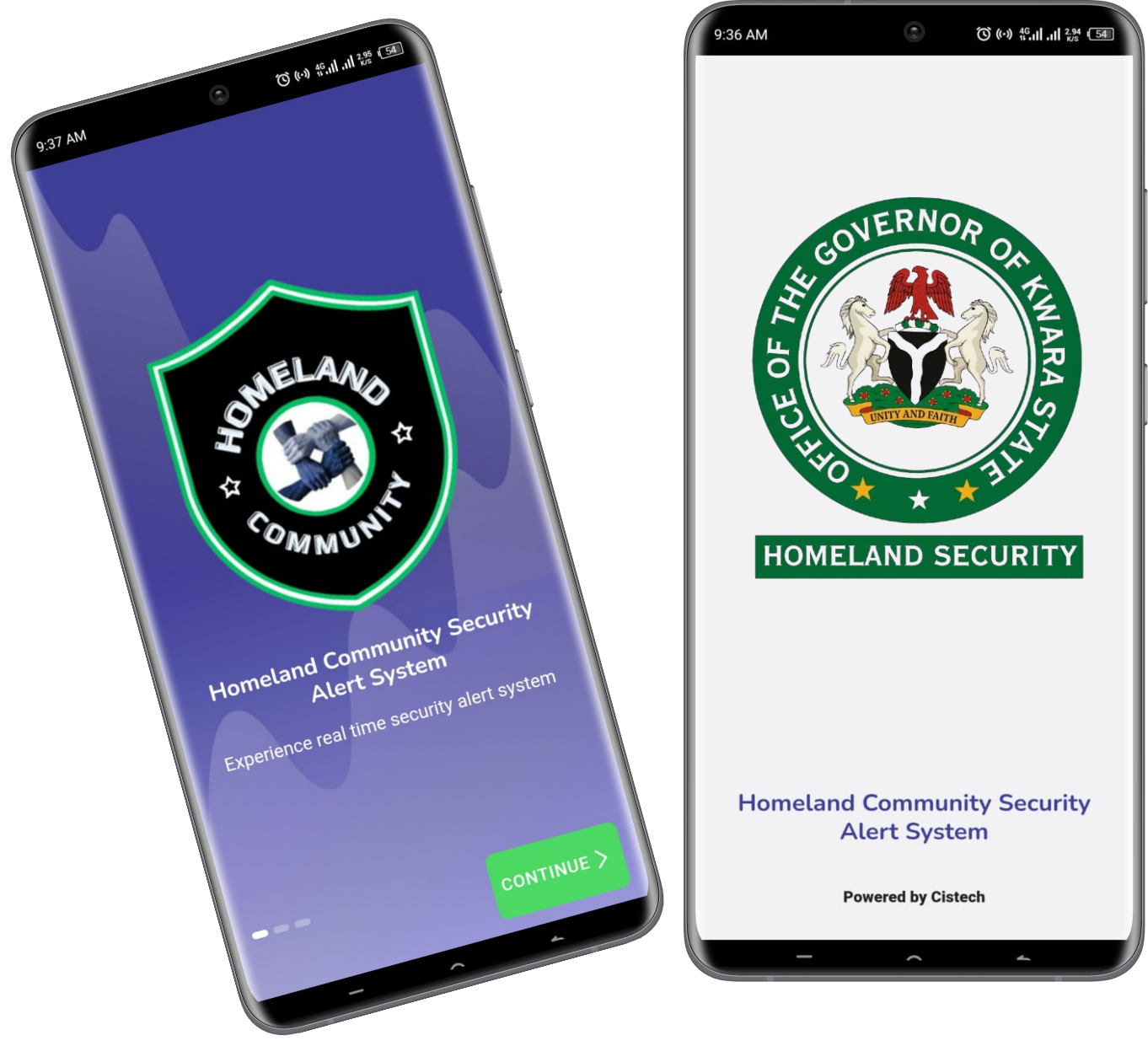
The Homeland CSAS is a project designed by CISTECH, a global technological solutions powerhouse in collaboration with Kwara State government.
The State of harmony.
Kwara State is one of the states in the North-Central geopolitical zone of Nigeria. It was created on 27 May 1967 and has Ilorin as its capital and largest city. The state occupies an estimated land mass of about 36,825 square kilometres, making it one of the moderately large states in the country.
Geographically, Kwara State lies between latitudes 7°45′ and 9°30′ North and longitudes 2°30′ and 6°25′ East. It shares boundaries with Niger State to the north, Oyo, Osun, and Ekiti States to the south, Kogi State to the east, and has an international boundary with the Republic of Benin to the west. This strategic location places Kwara at a cultural and commercial crossroads between northern and southern Nigeria.
Kwara State is often described as a “state of harmony” due to the peaceful coexistence of its diverse ethnic groups, including Yoruba, Nupe, Baruba, Fulani, and others. This diversity, combined with its central location, natural resources, and growing educational institutions, makes Kwara State an important link between different regions of Nigeria.
RECENT EFFORTS BY THE HIS EXCELLENCY, GOVERNOR AbdulRahman AbdulRazaq.
The Kwara State Government has recruited and deployed about 1,000 forest guards drawn from local communities to protect rural and forested areas that have been exploited by kidnappers and bandits. These guards work alongside the military, police, and other agencies to deny criminals safe havens in remote terrains. This marks a shift toward a more proactive and community-integrated security posture.
Governor AbdulRahman AbdulRazaq has strengthened collaboration with the Office of the National Security Adviser (NSA), the Nigerian Army, the DSS, and the police to coordinate offensive operations in troubled local government areas such as Ifelodun, Patigi, and Edu. Joint actions have resulted in neutralising suspected bandits and disrupting criminal networks.
--ThisDay Live.
The Kwara State Police Command has deployed tactical units and intensified visibility patrols across the state, especially during festive periods and other high-risk times, to safeguard lives, property, and public spaces like markets, worship centres, highways, and parks.
--Peoples Gazette Nigeria.
To develop short, medium, and long-term security strategies, the state government inaugurated a high-level security committee led by the Deputy Governor. This body is charged with proposing sustainable measures to curb breaches and enhance public safety across Kwara.
In response to a series of attacks, the government issued special security directives for schools in several local government areas (e.g., Ifelodun, Ekiti, Irepodun, Isin, Oke Ero). These included closures where necessary to protect pupils and prevent criminals from using students as leverage during security operations. Although schools are now reopening in most areas with improved conditions, special surveillance remains in place in some locations.
--Premium Times Nigeria.
Authorities, including the Kwara State Security Council, have called on citizens to provide timely and actionable intelligence to support security operations and to remain vigilant during large gatherings, such as religious services and holiday events.
Governor AbdulRahman AbdulRazaq continues to reassure residents of the government’s commitment to safety, urging balanced public reporting and partnership with communities to maintain peace and encourage steady investment and development.
The State of harmony.
It is a known incidence that Oba Simeon Olaonipekun, the Aniwo I of Aafin community in Ifelodun LGA, and his son were kidnapped during a violent palace attack on 31 December 2025. The gunmen stormed the palace late at night, and the monarch’s wife was injured in the assault. The attackers have reportedly demanded ransom of around ₦450 million for their release (including other victims taken nearby).
The recent incident follows another abduction of a traditional ruler, Oba Kamilu Salami (Ojibara of Bayagan-Ile) in November 2025, which heightened fears as the monarch remained in captivity for days, causing fear and anxiety in the community.
Kidnapping has become one of the most pervasive threats across Kwara, with rural and forested areas particularly hard hit: In 2025 alone, analyses indicate hundreds of abductions and deaths linked to suspected bandits and armed groups. Data from conflict tracking showed at least 177 people abducted and over 200 killed between January and November 2025.
Reports detail mass kidnappings of worshippers, farmers, traders, and travellers in several local government areas like Ifelodun, Patigi, Edu, Ekiti, Isin, and Irepodun, often involving ransom demands.
Attacks have forced community displacement, with residents fleeing towns like Oke-Ode after bandit attacks that killed vigilantes and traditional leaders.
1. high-profile kidnappings of traditional rulers and civilians with hefty ransom demands
2. sustained attacks by armed bandits and criminal groups across rural communities
3. deaths, displacement, and fear among ordinary citizens
4. environmental factors like forests and poor connectivity that enable persistent insecurity.